
Cedar Hall and the Architecture of Invitation

Updated: May 11
A conversation with Kyle Gaffney of SkB Architects on Cedar Hall, the design philosophy behind it, and what happens when a skyscraper decides to belong to everyone.

For decades, an atrium in the heart of downtown Seattle gave no one on the sidewalk a reason to stop. Granite-heavy and inward-facing, it offered nothing to anyone without business inside. No warmth. No curiosity. Nothing that said come in. You walked past because there was nothing to walk toward. And if you did go in, you finished what you came for and left.
That building is still there. What it holds now is something else entirely.
Cedar Hall, the 150,000-square-foot repositioning of the U.S. Bank Center by Seattle-based SkB Architects, is a public space unlike anything else on the West Coast. Strangers walk in off the street and stay. They find a seat, take in the scale of the hall, the light moving across the ceiling, the life happening around them. They come back. It was designed, from first concept to last detail, to be the kind of space a skyscraper rarely allows itself to be: open, active, and genuinely accessible to all.
The Tower and the Street

Walk past most high-rises in any major American city and the story at street level is a familiar one. Retail that serves the tenants above it. Ground floors that close when the tower does. Facades that give a pedestrian nothing to look at and no reason to slow down. At six in the evening the building empties and the block goes quiet.
This became the dominant model of commercial development through the second half of the twentieth century, and for building owners it worked: maximize leasable square footage, fill the ground plane with tenants, move on. The city outside and the people living in it got something less useful. The street-level experience became transactional at best, absent at worst.
"Society's relationship to these buildings has changed," says Kyle Gaffney, Founding Partner at SkB Architects. "The way people work is different. The way people live is different. And here are these towers that were built entirely around efficiency." The buildings were optimized for one thing: large numbers of office workers arriving in the morning, occupying floor plates, and leaving in the evening.
When SkB was brought in to reimagine the U.S. Bank Center, all three of its founding partners had spent years working in it as architects earlier in their careers. They came to the project with an intimate familiarity with its shortcomings: the escalators that blocked sightlines and produced a mall-like feel, the circulation that confused rather than guided, a ground plane that had never been designed to do more than the minimum. The chance was to design something that did more. Much more.
As much urban repair as architectural intervention, the project reframes the building and its surroundings as shared civic ground that is privately held, yet intentionally public-facing. A subtle but meaningful gift to the city.
The Invitation

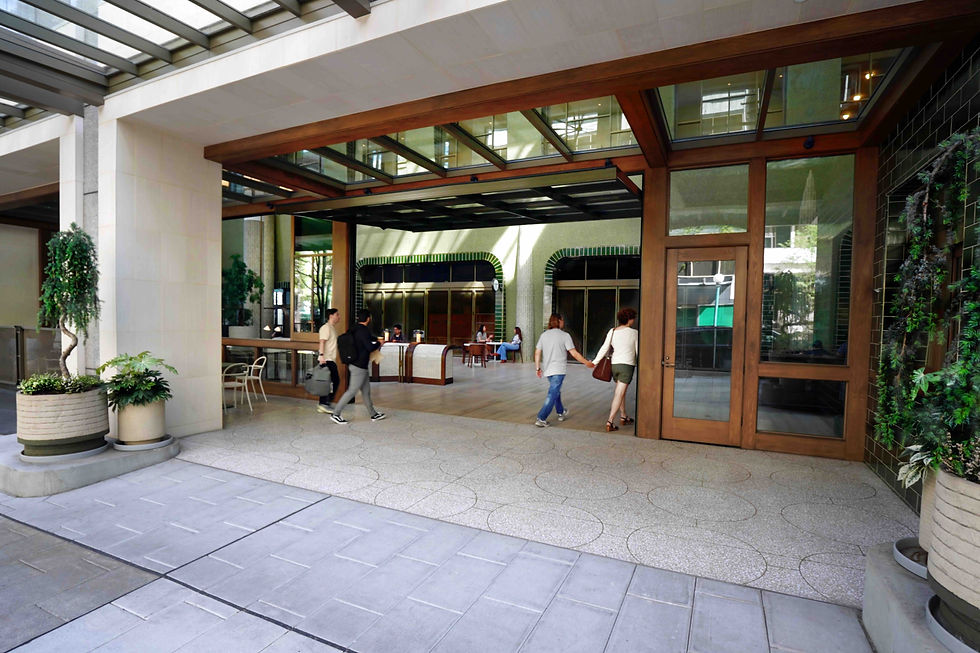
Cedar Hall's invitation begins at the building's edge. The large doors along Pike Street that fold open to the sidewalk. The window system that opens the hall directly to the street. Clear sightlines from the avenue that let a passerby see straight into the space before deciding whether to enter. Each element is doing the same work: dissolving the line between building and street, telling a pedestrian the threshold is there to be crossed.

"We wanted to blur the line between public and private," Gaffney says. "Can you create a storefront where somebody's going to walk by and be inquisitive? Where they say, I wonder what's in there?" Even on a gray Seattle afternoon, when the doors stay closed, you register what they could do. There is something aspirational about a facade that announces its own porosity.
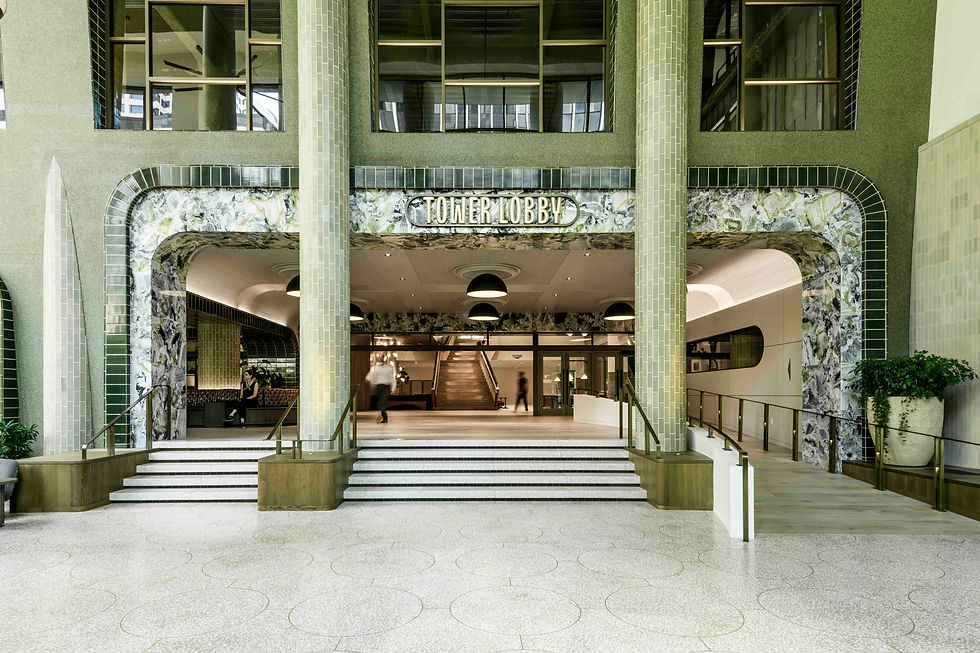
Inside, the invitation continues. Over 3.6 million hand-set green penny tiles wrap the hall's floors and walls and curve overhead into the ceiling, echoing the colors and landscape of the Pacific Northwest. They shift with the light throughout the day, giving Cedar Hall a quality that changes by the hour, even on overcast afternoons. Wood floors run through the space where a Class A tower would typically use stone. The furniture is scaled and arranged for people who intend to stay, the kind of seating that invites you to sit a while.
Every material choice carries the same message: you are welcome here, not merely permitted.
The Work Before the Marks
The coherence of Cedar Hall across three levels and 150,000 square feet did not come from applying a predetermined aesthetic to a new context. SkB does not work that way.
"A lot of architects have a design language they are trying to master over their career," Gaffney says. "That's not us. When we come to a project, we don't arrive with the answer. We want to understand the site, the context, the history of the place, and the people who are going to use it. The marks don't start until we've gotten potent with all of that."
The result is a design language that grows from the project itself rather than being applied to it. Clients are part of that process from the first rough sketches, not handed a finished proposal at the end of a closed design period. Their knowledge of the building, their instincts about the community, their responses to early ideas all become part of what the space ultimately is. What emerges is genuinely specific to its place and the people it serves.
"The marks don't start until we've gotten potent with all of that."
For Cedar Hall, that process ran a year and a half in design, with construction beginning in 2020 at the height of the pandemic. What could have become a stalled effort sharpened instead into something more urgent: a commitment to create a public space that would be waiting when the city was ready to come back.
The Part That Travels
Cedar Hall is drawing national attention now, and Gaffney is not surprised. The calls coming in from other cities are asking, in different forms, the same question: can we do this here?
What travels is the posture behind the project. The willingness to ask different questions. Who does this space send away? Who does it make invisible? What would it mean to design as though the person walking by mattered as much as the tenant above? Those questions are not tied to a corner or a budget. They can be asked on any block, in any city, at any scale.
"You have to have someone who understands their impact within a community," Gaffney says. "That's just not the typical."
The exception is what Cedar Hall sets out to be.
It points back to something cities knew before the high-rise era reshaped them. Ground floors were once the connective tissue of urban life, the layer where a building met its block and gave something back to the street. The wine bars and flower stalls and neighborhood destinations that make certain streets worth spending time on exist because the buildings containing them were designed to face outward. That relationship eroded through decades of development that treated the tower as the product and everything below it as secondary. Cedar Hall is a case for recovering it.
One Path
Something about the building had genuinely offended Gaffney the entire time he worked there: the accessibility ramps were hidden. Deliberately tucked behind planters and kiosks, routed away from the main circulation, they created a separate path through the building for anyone who could not use the stairs. A secondary experience, out of sight.
"I was truly offended by it," he says. "It was such a blatant thing. If I'm in a wheelchair, you're sending me around the planters, and nobody can see me. I think it was just really insensitive." He connects it to something broader: a long cultural habit of treating disability as something to be managed around rather than designed for.
At Cedar Hall, SkB eliminated the switchback ramps entirely. Continuous, gently sloping surfaces now allow every visitor to move through the space along the same path. Stairs and ramps are paired side by side. The accessible route is not a workaround; it is the primary circulation, the path everyone takes. It is not a technical decision, Gaffney says, but a philosophical one: a statement about who the space is for.
That conviction runs through everything Cedar Hall is. The transparency from every entry point. The way the space opens to the street and to the city around it. Every decision, from the largest structural move to the smallest material choice, was made in service of the same idea: that this place belongs to everyone who walks through the door.
"We wanted to make a place that people want to go to. That people are going to want to use."
Cedar Hall is not finished. More of what Gaffney imagined for the project is still on its way. But what already exists has made its case: that a tower at the center of a city can be generous by design. That the ground floor does not have to belong only to the people who work above it.
The doors are open. Everyone is welcome. That was always the point.
Since 1999, SkB Architects has designed sensory-rich environments that connect people, businesses, and communities from their Seattle studio. Learn more at skbarchitects.com.


Comments