
Tested by Nature: A Specifier's Guide to Material Performance

Updated: Apr 30

There is no universally correct answer to the question of which material belongs on a given project. There are, however, wrong answers. They tend to show up three to five years after a certificate of occupancy, in the form of rust streaks, failed finishes, swollen frames, and callbacks that no one budgeted for.
Material selection for doors and windows is one of the most consequential specification decisions on any project, and it is frequently made on aesthetic grounds alone. The visual case for steel, bronze, or natural wood is easy to make. The performance case is harder, and it varies significantly by geography, exposure, and climate type. A system that performs beautifully in a temperate mid-Atlantic climate may be fundamentally unsuited to a coastal site in the Florida panhandle or a high-alpine residence outside Aspen.
This guide covers five materials: steel, bronze, aluminum, wood-clad, and wood. Each is evaluated across four climate categories: coastal and marine, alpine and high-altitude, desert and arid, and freeze-thaw. Each material section addresses durability, maintenance expectations, aesthetic evolution over time, and the environments where it performs best and worst.
The goal is not to declare a winner. It is to give you the information to avoid a costly mismatch.
STEEL
The Material That Built Modernism

Steel frames defined the visual language of twentieth-century modernism. The slim sightlines, the industrial shadow lines, structure made visible rather than hidden -- these were not incidental qualities. They were the aesthetic. Architects from Mies to Chareau built entire vocabularies around what steel could do that no other material could replicate.
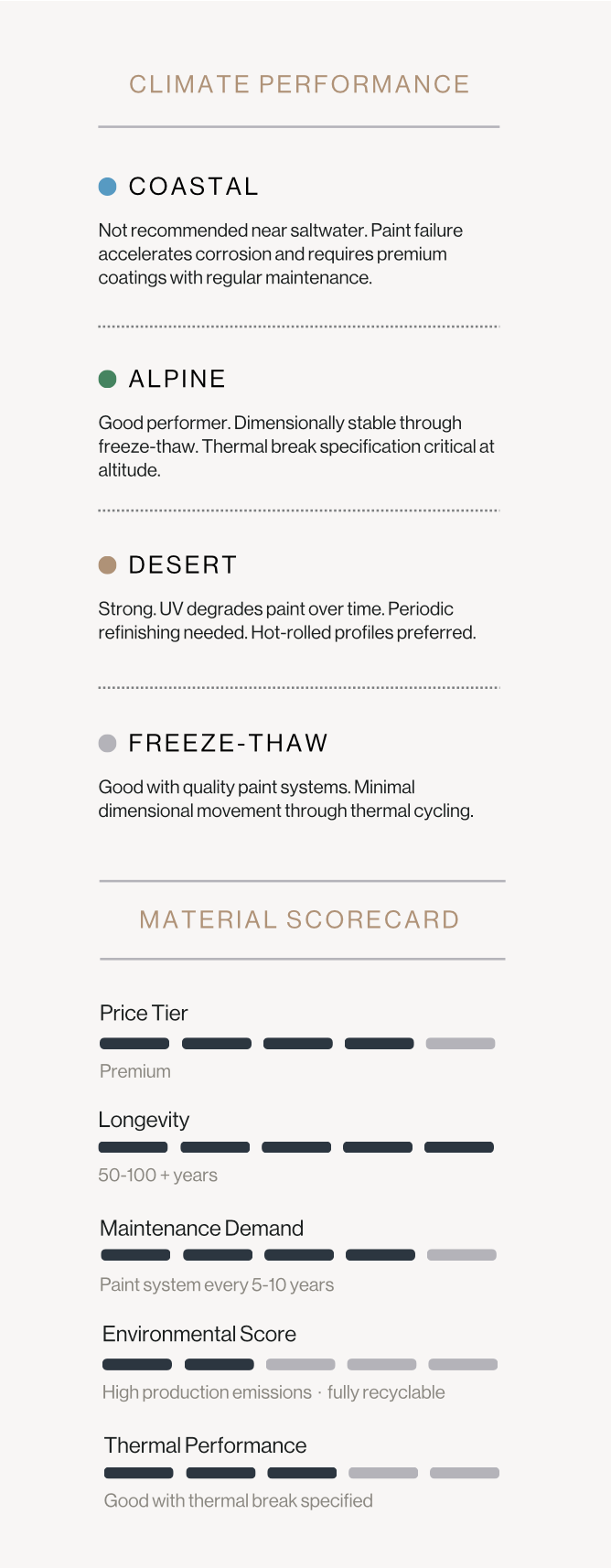
The constraint that governs every steel specification decision is rust. Unprotected steel in a wet or saline environment begins to corrode immediately. Damaged paint systems must be identified and repaired before moisture reaches the substrate -- and once corrosion takes hold it is self-accelerating.
Thermally broken steel systems address the performance gap that traditional profiles cannot close. A polyamide or aerogel thermal break interrupts the direct metal-to-metal conduction path, bringing U-values into range for contemporary envelope requirements. The manufacturing process is labor-intensive, which is reflected in price. Premium steel systems sit at or above the cost of bronze.
A Specifier’s Note
Steel's coastal reputation doesn't transfer to dry mountain environments. Above 6,000 feet, the conditions that destroy steel simply don't exist -- low humidity, minimal salt exposure, and temperature swings that punish organic materials but leave steel entirely unaffected. The specification case for alpine steel is consistently underestimated.
Dimensional stability is steel's defining alpine advantage. Where wood swells seasonally and wood-clad systems stress through freeze-thaw cycling, steel holds its geometry. Frames stay true. Seals stay intact.
UV intensity at altitude will degrade any paint system over time. A quality coating specified for alpine exposure, applied over hot-dip galvanized steel, addresses this directly. In a dry mountain climate that maintenance cycle is predictable and significantly longer than coastal equivalents.
For mountain residential projects calling for slim sightlines and frames that read as structure rather than infill, steel is the correct answer. The coast is where steel struggles. The mountain is where it belongs.

BRONZE
The Only Material That Gets Better

Bronze is the only material in this category where aging is an asset rather than a liability. Every other material in this guide requires intervention to maintain its appearance -- paint systems, refinishing, replacement of degraded components. Bronze requires none of that. The patina that develops on a bronze frame over time is not deterioration. It is a protective oxide layer that actively seals the surface against further corrosion. Left alone, bronze improves.
Bronze thrives where other materials fail. In coastal conditions where steel corrodes and aluminum pits, bronze patinates.
Salt air that strips paint from a steel frame simply accelerates the protective layer on bronze. For waterfront and exposed sites, the specification case has never been purely aesthetic -- it’s that bronze is the only material that removes maintenance from the equation entirely.
Thermally broken bronze systems bring the material into compliance with contemporary envelope requirements. Polyamide thermal breaks interrupt the cold bridge, and European manufacturers now produce panels up to 8 feet wide by 20 feet tall. The manufacturing process is highly skilled and labor-intensive, which places bronze at the top of the price range in this category. It is not a value specification. It is a generational one -- chosen with the understanding that it will outlast every other component of the building it goes into.


The patina is not the problem. The patina is the point.
Factory patina options allow architects to specify the finished appearance at installation rather than waiting for natural development. Natural patina options allow the material to evolve with the building over decades. Both are valid. The choice depends on whether the project calls for immediate visual arrival or a surface that tells the story of time.
ALUMINUM
The Most Versatile Performer

Aluminum is the material that quietly dominates contemporary architecture -- particularly in the American West, where it arrived in the postwar era not as a substitute for older materials but as a deliberate rejection of them. The East held to its roots: double-hung windows, divided lights, white paint. The West was building something new, and aluminum said so. Not the most dramatic specification -- that is bronze. Not the most historically loaded -- that is steel. It solves the most problems without asking much in return.
The thermal performance story has changed fundamentally over the past two decades. Early aluminum profiles conducted cold directly from exterior to interior -- a liability in high-performance envelopes. That reputation stuck, and for unbroken profiles, it remains deserved.
Thermal break technology eliminated that weakness. Polyamide breaks interrupt conduction at the frame junction, and modern thermally broken systems achieve U-values that meet or exceed steel and bronze equivalents.
Corrosion resistance is genuine and requires no maintenance intervention. Aluminum forms a natural oxide layer that protects the substrate without paint. Anodized and powder-coated finishes extend the aesthetic range considerably -- from raw industrial to refined architectural -- without compromising that protection.
Color consistency across large facade areas is another practical advantage: aluminum holds finish uniformity that wood and wood-clad systems cannot reliably match at scale. In coastal environments aluminum performs meaningfully better than steel, though it will pit over time in direct marine exposure. For most sites it is effectively maintenance-free.
The sustainability profile is complicated by one variable: how the aluminum was produced. Virgin aluminum smelting is one of the most energy-intensive industrial processes in manufacturing.
Recycled aluminum requires approximately 5% of that energy, and recycled content specification is increasingly available. For projects targeting embodied carbon benchmarks the sourcing question is worth asking directly of the manufacturer before the product is specified.


WOOD-CLAD
The Best of Both Worlds

Wood-clad systems exist because wood and aluminum each solve problems the other cannot. Wood is a natural insulator with low embodied carbon and genuine warmth that no metal profile replicates. Aluminum is dimensionally stable, corrosion resistant, and essentially maintenance-free on an exterior exposure. Wood-clad combines them -- wood core for thermal performance and character, aluminum cladding for weather resistance and longevity. The result is a system that neither material could achieve independently.
The thermal performance result is the best in this category. Wood is a natural thermal break. The combination of wood's insulating properties with a well-designed aluminum exterior produces U-values that outperform thermally broken metal systems across the board.
For passive house projects, high-performance envelopes, or any project where the thermal specification is driving decisions, wood-clad is the logical answer.
The durability equation depends on the aluminum exterior doing its job. When it does -- when seals are intact and water is managed away from the wood core -- wood-clad systems perform for decades with minimal intervention. When moisture reaches the wood core, the failure mode is the same as any wood product: swelling, distortion, eventual rot.
Specification and installation quality matter more for wood-clad than for any other material in this guide.
End-of-life recovery is the honest weakness. The aluminum exterior and wood core are theoretically separable, but in practice most wood-clad frames are landfill-bound at replacement. The sustainability story is strong at the front end -- low embodied carbon, carbon sequestration in the wood -- and weaker at the back end than aluminum alone.


WOOD
The Oldest Material. Still the Right Answer.

Wood is the oldest material in this category by several thousand years and still the right answer in specific conditions. The question is never whether wood is beautiful -- it is -- but whether project conditions will allow it to perform.
Wood sits at one end of the design spectrum alongside bronze -- both are choices for the discerning client willing to commit fully to the material. Where bronze demands nothing, wood demands everything. That tension is the appeal for the right client, and the risk for the wrong one.
A well-designed wood frame performs comparably to thermally broken metal systems without requiring an engineered break -- a natural advantage in cold climates and high-altitude applications.
Species selection is the most consequential decision. Mahogany is the benchmark -- dimensionally stable, naturally oil-rich, and inherently rot-resistant. Accoya, an acetylated radiata pine with dramatically improved stability, offers comparable performance at a different price point.
Maintenance demand is wood's defining liability. Finish systems must be inspected regularly and refinished before moisture penetrates the substrate. A missed maintenance window is not cosmetic -- it is the beginning of a failure sequence that ends in replacement. The maintenance cycle is not a flaw in the material -- it is the cost of what the material delivers, and the right client understands that trade-off before they specify it. In humid, coastal, or high-rainfall environments that cycle is frequent and non-negotiable.
Wood performs best in dry, temperate, and protected conditions. Covered openings, deep overhangs, and sheltered exposures extend lifespan significantly. Exposed facades in wet or coastal climates are where wood struggles most. The specification should honestly assess exposure before committing to the material.
The sustainability story is the strongest in this guide. Wood has the lowest embodied carbon of the five materials and actively sequesters carbon during growth. FSC certified sourcing closes the loop. For projects where sustainability specification matters as much as performance, wood makes a case no other material can match.


Five Materials. One Decision.
All five materials evaluated across the same criteria. Read down a column to assess a single material. Read across a row to compare materials on a single criterion.

No single material wins every column.
The goal of this guide is not to declare a winner. It is to give you the information to avoid a costly mismatch. Bronze leads on longevity and maintenance. Wood on environmental score. Aluminum on versatility and value. Steel in the alpine environments it was built for. Wood-clad on thermal performance, offering a middle path between the character of wood and the durability of metal.
The right material matches the project conditions honestly. The climate, the exposure, the maintenance capacity of the owner, the architectural intention. The most considered specifications blend materials deliberately. Bronze on the exposure side, wood on the protected side. The specification decision is knowing not just which material, but where each one belongs.


Comments